48 practice problems. Eight worked models. One dimension, understood thoroughly.
Your flight procedure
Predict a sign or direction, calculate with units, then enter your results in the matching K activity before observing. Keep the first prediction when correcting. Use G/U for givens and unknowns, E for the equation, and S/S for substitution and solution. The printable manual provides two practice problems per page.
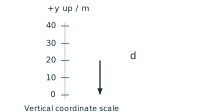
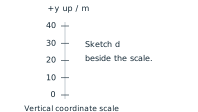
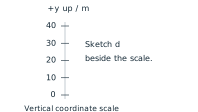
The coordinate scale has no arrowheads. Horizontal displacement legs sit above it; vertical legs sit beside it. Playback shows only motion already observed. Velocity and acceleration have separate fixed scales. A zero vector is a dot. The optional red, hatched cancellation hint pairs opposite traveled portions; both still count toward distance.
Positive x is right; positive y is up. Use SI units. Gravity appears only in Earth-surface problems, with g = 9.8 m/s². The web notation setting does not change the physics. Instructor review remains separate from numerical verification.
Equations and graph relationships
d = xf - xi Signed displacement; use y for vertical motion.
v̄ = d / t Average speed instead uses total distance / elapsed time.
a = (vf - vi) / t Average acceleration; equal to the uniform value in a constant-acceleration interval.
vf = vi + at Constant acceleration over the selected interval.
d = vi t + ½at2 Constant acceleration. Add the initial coordinate to find final position.
vf2 = vi2 + 2ad No time needed. Choose the velocity sign from physical direction.
v̄ = (vf + vi) / 2 Requires constant acceleration across the entire interval.
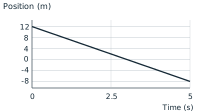
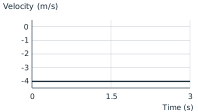
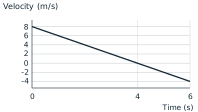
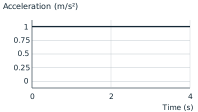
Position-time slope gives velocity; velocity-time slope gives acceleration. Signed velocity-time area gives displacement; acceleration-time area gives change in velocity. For distance, add the magnitudes of velocity-time areas split at each zero crossing.
Reference: supplied NYSED Physics Reference Tables (2025), pp. 1-2. Graph rules are applications. A bar over v denotes an average. The online AP / Compare setting presents equivalent component notation.
01 · Position and displacement
K00 / WORKED MODEL
Your first displacement
A craft starts at x = -20 m and finishes at x = +20 m. Positive x points right. Predict its displacement, then observe the prescribed flight.
Find: signed displacement (m).
E: d = xf - xi
Final position minus initial position: 20 - (-20) = +40 m.
The craft moves 40 m in the positive direction. A negative starting coordinate does not mean negative displacement.
Explain: If both coordinates increased by 100 m, would displacement change? Explain.
The checkpoint log lists these coordinates in order: start -20 m, turn -5 m, finish -65 m. Find the net displacement. Treat the entries as positions on one fixed x axis.
Find: signed displacement (m).
Explain: Write a signed change for each leg. Explain why the intermediate coordinate cancels in their sum.
Observer A records the craft moving from +15 m to +45 m. Observer B uses the same positive direction but adds 100 m to every coordinate, recording +115 m to +145 m. Calculate the displacement reported by A, then judge the claim below.
Find: signed displacement (m).
Which report is physically consistent? A. Both report the same displacement. / B. B reports 100 m more displacement. / C. B reports the opposite displacement.
Explain: Calculate B's displacement and explain which measurement changes when only the origin changes.
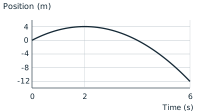
Read the supplied position-time graph over 0 to 6 s. The turning point is (2 s, +4 m). Find net displacement and total distance; a curved graph still represents positions.
Read exact graph data
Position (m)
Time (s)
Value
0
0
1
3
2
4
3
3
4
0
5
-5
6
-12
Find: signed displacement (m); total distance (m).
Explain: Explain why the highest point of this position graph marks a reversal rather than the greatest speed.
A craft moves from x = 0 m to +8 m, waits there, then returns to 0 m. It next moves to +4 m. Find distance and net displacement for the complete route. The waiting interval adds no travel.
Find: signed displacement (m); total distance (m).
Explain: Break the route into nonnegative lengths. Explain why waiting does not add distance.
An inspection route starts at x = -10 m, reaches +26 m, then returns to +10 m. The drive has a 50 m travel allowance, based on total distance. Calculate distance and net displacement, then decide whether the allowance is sufficient.
Find: signed displacement (m); total distance (m).
Can the complete route fit within 50 m of travel? A. Yes, because the net displacement is only 20 m. / B. No, because both legs use the allowance.
Explain: Explain why using net displacement to check the allowance would produce the wrong decision.
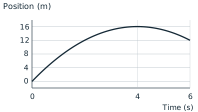
The position-time trace shows a craft starting at 0 m, reaching +16 m at 4 s, and finishing at +12 m at 6 s. Find average velocity and average speed for the full six seconds.
Read exact graph data
Position (m)
Time (s)
Value
0
0
1
7
2
12
3
15
4
16
5
15
6
12
Find: average velocity (m/s); average speed (m/s).
Explain: Explain why total elapsed time belongs in both averages even though the craft reverses.
A craft travels 18 m in the positive direction during its first 6 s, arriving at rest, then waits for 3 s. Find average velocity and average speed over the complete 9 s record.
Find: average velocity (m/s); average speed (m/s).
Explain: Compare the average over the moving interval with the average over the complete record.
A craft coasts at -6 m/s from x = +36 m to x = -18 m. The docking window closes 8 s after departure. Find the travel time, then decide whether the craft arrives by the deadline.
Find: elapsed time (s).
Does this flight meet the deadline? A. Yes, it arrives within 8 s. / B. No, it arrives after 8 s.
Explain: Justify the sign of the displacement and why the resulting elapsed time must be positive.
A craft starts at -3 m/s. It accelerates at +2 m/s² for 2 s, then its acceleration becomes zero for another 3 s. Find the final velocity after both stages.
Find: final velocity (m/s).
Explain: Calculate the velocity at the stage boundary. Explain what persists when thrust ends.
A craft starts at +6 m/s and accelerates continuously at -2 m/s² for 5 s. Find final velocity and evaluate the claim that it slows throughout the entire interval.
Find: final velocity (m/s).
Which description is correct? A. It slows for all 5 s. / B. It slows, reverses, then speeds up. / C. It speeds up for all 5 s.
Explain: Use velocity and acceleration directions on each side of the turning instant to justify your decision.
Starting at x = -10 m with velocity +2 m/s, a craft accelerates at +2 m/s² for 3 s. It then coasts for 2 s. Find total displacement and final position.
Find: signed displacement (m); final coordinate (m).
Explain: Show a separate calculation for each stage. Which velocity starts the coasting stage?
A craft starts from rest, accelerates at +3 m/s² for 2 s, then coasts for 4 s. Find total displacement and average velocity. A pilot instead averages the initial and final velocities for the entire trip.
Find: signed displacement (m); average velocity (m/s).
May endpoint averaging replace the stage calculations here? A. Yes, for every flight. / B. No, acceleration changes between stages.
Explain: Compare the pilot's shortcut with your result. State the condition required for endpoint averaging.
A craft moving at +12 m/s must stop after a displacement of +24 m. Assume constant acceleration. Find the required acceleration without first calculating time.
Find: constant acceleration (m/s²).
Guidance: Use v_f² = v_i² + 2ad and isolate a.
Explain: Explain why the sign of acceleration must oppose the initial velocity.
A craft moves at +10 m/s from x = 0 m. It coasts for a 1 s response delay, then brakes constantly at -2 m/s² until rest. A boundary lies at x = +34 m. Find total travel to rest and total elapsed time.
Find: signed displacement (m); elapsed time (s).
Will it stop before the boundary? A. Yes. / B. No.
Explain: Separate response distance from braking distance and quantify the boundary clearance or overrun.
A craft has 36 m of clearance and can maintain acceleration -2 m/s² while moving right. There is no response delay. Find the greatest initial velocity that allows it to reach rest exactly at the boundary.
Find: initial velocity (m/s).
Explain: Would +13 m/s satisfy the same clearance? Calculate its stopping distance to support your answer.
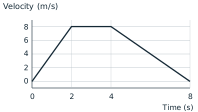
A flight has the supplied velocity-time graph: velocity rises from 0 to +8 m/s during 0-2 s, stays at +8 m/s during 2-4 s, then falls to 0 during 4-8 s. Find displacement and average velocity. A pilot claims equal endpoint velocities imply zero displacement.
Read exact graph data
Velocity (m/s)
Time (s)
Value
0
0
1
4
2
8
3
8
4
8
5
6
6
4
7
2
8
0
Find: signed displacement (m); average velocity (m/s).
Is the zero-displacement claim correct? A. Yes, because initial and final velocities match. / B. No, because the velocity-time area is positive.
Explain: Use the three graph areas to evaluate the claim; distinguish change in velocity from displacement.
In an Earth-surface test chamber, a marker is released from y = 20 m. Positive y is upward. Ignore air resistance and use g = 9.8 m/s². Find its displacement and height after 2 s.
Find: vertical displacement (m); final height (m).
E: dy = viy t + (1/2)ay t2; yf = yi + dy
Vertical displacement: 0(2) + (1/2)(-9.8)(2²) = -19.6 m.
Final height: 20 - 19.6 = 0.4 m.
Explain: Why is acceleration negative when g itself is a positive magnitude?
In the Earth-surface chamber, use +y upward, g = 9.8 m/s², and no air resistance. A marker is released from rest at y = 30 m. Find vertical displacement and height after 1 s.
Find: vertical displacement (m); final height (m).
Guidance: Use a = -g. Calculate the change in height before the final height.
Explain: Distinguish the positive magnitude g from the signed acceleration a.
In the Earth-surface chamber, use +y upward, g = 9.8 m/s², and no air resistance. A marker starts at y = 30 m with velocity -4.9 m/s. Find its velocity and height 1 s later.
Find: final velocity (m/s); final height (m).
Explain: Explain why both velocity and acceleration are negative while speed increases.
In the Earth-surface chamber, use +y upward, g = 9.8 m/s², and no air resistance. A marker starts at y = 5 m with velocity +19.6 m/s. Find its height and velocity after 1 s.
Find: final height (m); final velocity (m/s).
Explain: Sketch separate velocity and acceleration arrows. Explain why they point in opposite directions.
In the Earth-surface chamber, a marker starts at y = 10 m moving upward at +9.8 m/s. Use constant acceleration -9.8 m/s² and ignore air resistance. Find displacement and final velocity after 2 s.
Find: vertical displacement (m); final vertical velocity (m/s).
At the highest point, acceleration is... A. -9.8 m/s² / B. zero / C. +9.8 m/s²
Explain: Compare your first prediction with the observed motion. Explain any correction using an equation or graph.
In the Earth-surface chamber, use +y upward, g = 9.8 m/s², and no air resistance. A marker is launched upward at +9.8 m/s from y = 14.7 m. Find the time until it first reaches the floor at y = 0 m and its velocity immediately before arrival.
Find: elapsed time (s); final velocity (m/s).
Explain: Show the time equation. Explain why a negative time root does not describe this flight.
In the Earth-surface chamber, use +y upward, g = 9.8 m/s², and no air resistance. A marker leaves y = 0 m at +19.6 m/s. It passes y = 14.7 m once upward and once downward. Find the later passage time and its velocity then.
Find: elapsed time (s); final velocity (m/s).
Explain: Find both passage times. Explain why the two velocities have equal magnitudes and opposite signs.
 FIRST LIGHT ACADEMY